
UK consultation proposes EV credits for grid-feeding tech
A closed government review suggests manufacturers could earn offsets for adding bidirectional charging, potentially allowing more petrol sales while the grid balances renewables.
By Patrick Murphy ·
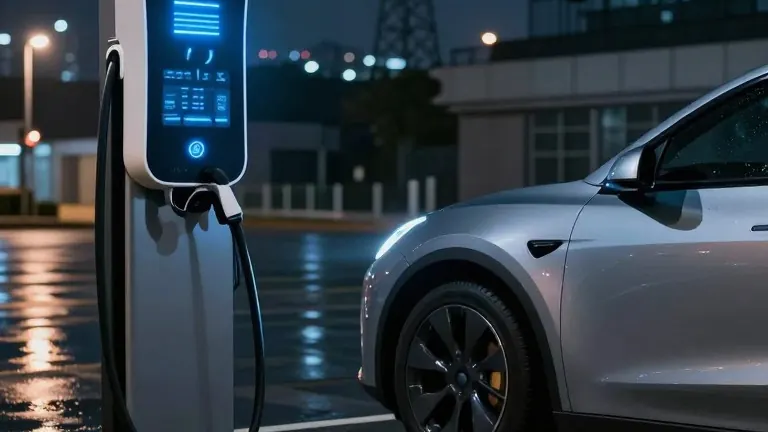
The United Kingdom government is considering a financial incentive for automotive manufacturers to install vehicle-to-grid technology in electric cars. The proposal, detailed in a consultation that ended on Friday, aims to encourage the adoption of bidirectional charging systems. These systems allow vehicles to act as mobile energy storage units rather than just consumers of electricity.
Under the plan, carmakers could earn a credit for each vehicle sold with this specific hardware. The credit would function as an offset within the zero-emission vehicle mandate. Specifically, it would permit manufacturers to sell additional petrol-powered models without facing penalties for missing their electric vehicle targets. The government is currently reviewing the mandate and preparing to adjust electric vehicle sales targets.
The technical mechanism allows drivers to charge their vehicles automatically when electricity prices are low, typically overnight. The system then enables the car to send that stored power back to the national grid during periods of high demand. This two-way flow helps balance the supply of renewable energy, which can fluctuate based on weather conditions like wind speed or sunlight.
Proponents argue that this technology could reduce the need to activate expensive gas power plants to cover gaps in supply. The National Energy System Operator, which manages the grid in Great Britain, estimates that vehicle-to-grid power could reach 1.2 gigawatts by 2030. By 2050, the forecast rises to 41 gigawatts, a capacity sufficient to meet more than a quarter of peak energy demand.
Critics, however, question the timing and the value of the proposed credits. Ben Nelmes, chief executive of the thinktank New AutoMotive, noted that the technology is not yet widely used by drivers. He warned that the current proposal offers one or two extra credits worth approximately £4,000 each. Nelmes stated that this amount far exceeds the cost of the hardware, which he estimated at a few hundred pounds, despite many drivers lacking the expensive chargers required to use the feature.
Vicky Edmonds, chief executive of the Electric Vehicle Association England, described the move as premature. She emphasized that only a small fraction of the millions of electric vehicle drivers in the UK currently use vehicle-to-grid or storage technologies. Edmonds argued that consumers are still focused on immediate concerns such as vehicle purchase costs and charging expenses, rather than advanced grid services.
Environmental groups have also raised concerns about the potential impact on emissions. They anticipate that changes to the zero-emission vehicle mandate could result in an additional 147 million tonnes of carbon entering the atmosphere by 2050. The incentive structure effectively allows manufacturers to prioritize the sale of polluting petrol models in the near term.
Some drivers already participate in similar schemes through service providers like Octopus Energy in the UK, Renault in France, and BMW in Germany. Octopus Energy has claimed that participants in its program could save £620 annually. The government has not yet finalized the rules for the new credits, leaving the exact financial structure of the mandate under review.
Source: The Guardian
More Business · Customer Complaints · Report a business · Got a Story?